


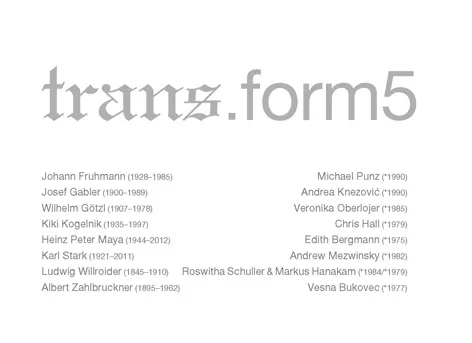
Mit TRANS.form 5 wird ein schon seit einigen Jahren erfolgreich umgesetztes Projekt in neuer Zusammenstellung gezeigt.
Die Grundkonzeption ist die Gegenüberstellung von alt und jung:
Junge Künstlerinnen und Künstler sind eingeladen, ihre aktuelle künstlerische Arbeit in Dialog mit ausgesuchten Werken verstorbener Mitglieder des Kunstvereins zu stellen, wobei dies sowohl über formale als auch inhaltliche Kriterien geschieht. Ihre Arbeiten beziehen sich auf die ausgewählten Originalwerke der Verstorbenen, nicht als Hommage, sondern als „Teil des Werks“ des Künstlers und der Künstlerin, um eine spannende Kommunikation zwischen Vergangenheit und Gegenwart, ein Zwiegespräch, das rein über die Arbeiten geführt wird, zu entwickeln.
Die paarweise präsentierten Werke spannen einen Bogen von der Vergangenheit in die Gegenwart, von der Tradition zur Avantgarde, von klassischen Techniken bis hin zu konzeptuellen Installationen.
Die diesjährigen Paarungen sind:
- Johann Fruhmann (1928 – 1985)
- Michael Punz (*1990)
- Josef Gabler (1900 – 1989)
- Andrea Knezović (*1990)
- Wilhelm Götzl (1907 – 1978)
- Veronika Oberlojer (*1985)
- Kiki Kogelnik (1935 – 1997)
- Christof Hall (*1979)
- Heinz Peter Maya (1944 – 2012)
- Edith Bergmann (*1975)
- Karl Stark (1921 – 2011)
- Andrew Mezvinsky (*1982)
- Ludwig Willroider (1845 – 1919)
- Roswitha Schuller + Markus Hanakam (*1984 / *1979)
- Albert Zahlbruckner (1895 – 1962)
- Vesna Bukovec (*1977)
Vesna Bukovec is participating with the drawing series There is no society without spectacle (2011–).
Artist statement:
Fascination with the collective experiences
Of the works by Albert Zahlbruckner, I was attracted by the painting ‘Feiertag in Maria Saal’ (1934). Despite the fact that at first sight there are no obvious parallels between this painting and my work, I thought it would be interesting to confront it with my series of drawings ‘There is no society without spectacle’ (2011–). The open ended series of so far nine conceptual drawings which are based on photographs found on the Internet and depict various mass events (protests in New York and in Slovenia, desperate factory workers, spectators at a tennis tournament, customers waiting for the official release of the new i-phone, the audience at a rock concert, school children at prayer, refugees struggling for their package of food and refugees rescued from a shipwreck). All these scenes have in common a crowd of people at a special pleasant or unpleasant event. As the theorist Jean-Luc Nancy would say: there is no society without spectacle; or more precisely, there is no society without the spectacle of society . … There is no society without the spectacle beacause society is the specatacle of itself. One could say that the painting of the pilgrimage in 1934 is presenting the current spectacular event in the local environment of the artist.
Supported by Skica
- Kunstverein Kärnten
- Goethepark 1
- A-9020 Klagenfurt
- t: +43 (0)463 55383
- e: office@kunstvereinkaernten.at
- www.kunstvereinkaerten.at